1. Why Recycle Concrete On-Site?
Cost Reduction: Turning a Liability into an Asset
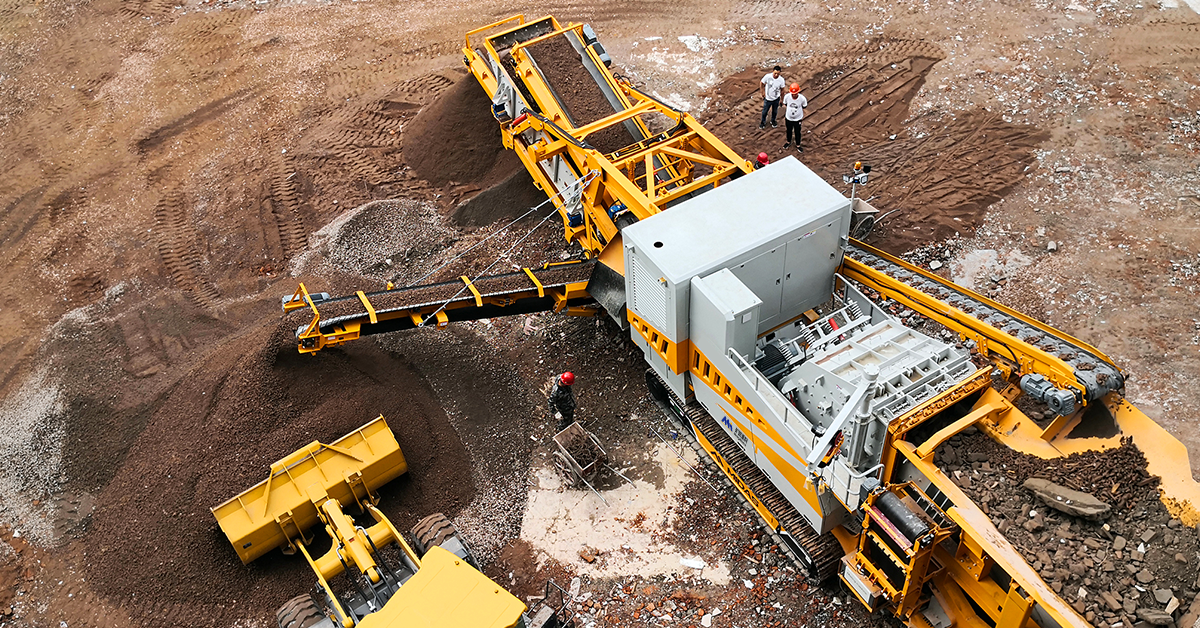
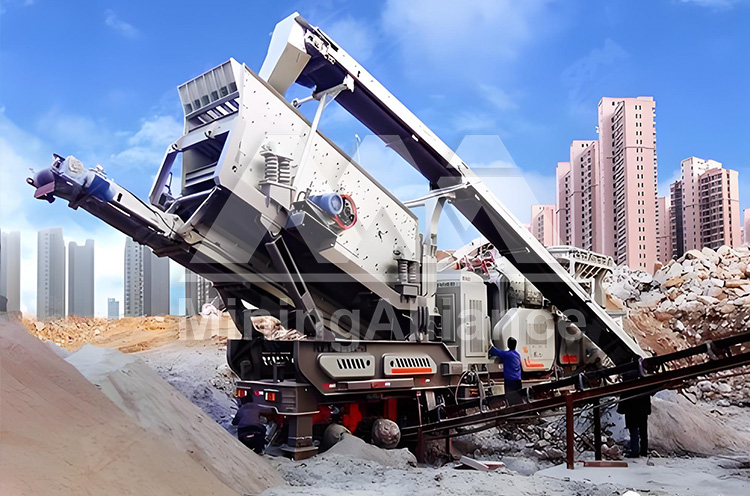
Traditionally, waste concrete had to be transported off-site for disposal — an expensive process involving dump fees, trucking costs, and fuel. By crushing concrete on-site with a mobile crusher, companies remove or greatly reduce those costs.
Hauling and disposal savings: Transporting concrete debris can cost $10–$20 per ton in fuel, labor, and tipping fees, depending on the region.
Aggregate production: The recycled concrete aggregate (RCA) generated by on-site crushers can replace virgin materials like crushed stone or gravel in applications such as sub-base, pipe bedding, or even new concrete mix designs that permit recycled content.
A mid-size demolition project producing 5,000 tons of waste concrete might save $50,000–$100,000 by reusing the material on-site — a direct, measurable boost to project margins.
Environmental Impact: Lower Carbon, Less Waste
Concrete recycling has gained traction as part of the global effort to cut construction-related greenhouse gas emissions. Crushing and reusing concrete on-site supports multiple sustainability goals:
Reduced landfill waste: Concrete takes up enormous space in landfills and can release alkaline leachate. Recycling diverts thousands of tons from disposal.
Reduced extraction of natural resources: Replacing virgin aggregates helps preserve rivers, mountains, and other natural sources often mined for stone and gravel.
Faster Project Turnaround
On-site recycling does more than save money and emissions — it also speeds up project delivery. Instead of coordinating multiple trucking operations, contractors can process waste concrete directly behind the demolition area. Crews can immediately repurpose the recycled material for new footing, road base, or site stabilization.
When Mobile Crushing Makes Sense
Mobile concrete recycling is not universally ideal. It excels under certain conditions:
In contrast, very small projects (under a few hundred tons) may find it more economical to send material to a central recycling yard or rent a compact crusher temporarily.
Fixed crushing plants remain advantageous for extremely high-volume, consistent material streams (e.g., regional recycling operations or long-term aggregate supply facilities). But for mobile projects, mobility equals money saved and emissions avoided.

2. Types of Mobile Crushers Used for Concrete Recycling
Modern mobile crushers come in several configurations, each optimized for different material types, volumes, and desired finished products. Understanding their characteristics helps contractors select the right machine for their recycling goals.
Mobile Jaw Crushers
Best for: Primary crushing of large, reinforced concrete chunks.
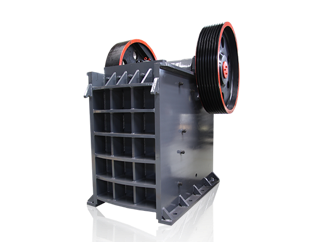
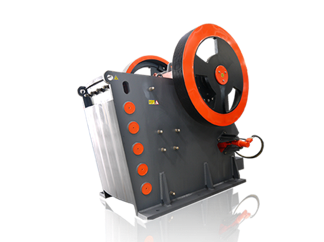
Mobile jaw crushers feature a fixed and a moving jaw plate that compress the material. They excel in the initial stage of processing large, bulky demolition material, often containing rebar or mesh.
Advantages:
- Handles heavy, reinforced concrete with minimal clogging.
- High throughput and mechanical simplicity.
- Produces coarse base aggregate suitable for fill, road sub-base, or subsequent crushing.
They’re typically the first stage in two-step crushing setups, preparing material for finer secondary processing via an impact or cone crusher.
Mobile Impact Crushers
Best for: Secondary crushing, producing cubical, high-quality aggregate.
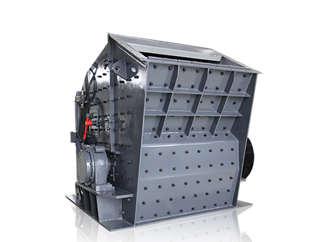
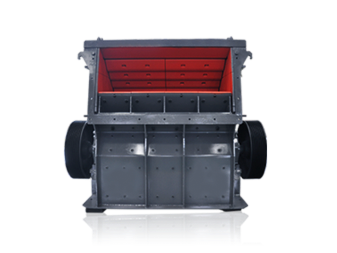
Impact crushers use a high-speed rotor with blow bars to strike material and break it apart. They’re especially valued for producing well-shaped, uniform aggregate — ideal for asphalt and concrete mix designs.
Advantages:
- Produces superior cubical product.
- More efficient for medium-strength concrete and asphalt.
- Versatile output size control via adjustable rotor speed and screen settings.
Considerations: Impact crushers experience more wear when processing rebar-heavy material, so they may require pre-sorting or a magnetic separator to remove metal contamination efficiently.
Mobile Cone Crushers
Best for: Secondary or tertiary crushing, shaping, and producing fine aggregates.
Cone crushers compress material between a rotating cone and stationary bowl. While less common for pure demolition recycling, they are valuable in multi-stage setups that require precise gradation of final material.
Advantages:
- Excellent for producing consistent, fine aggregate.
- Ideal in combination with jaw or impact crushers for multiple product sizes.
- Efficient for mixed rubble recycling with stone or masonry.
Tracked (Crawler) vs. Wheeled Crushers
Crushers come in tracked or wheeled (tire-mounted) configurations, each with trade-offs suited to different operating conditions.
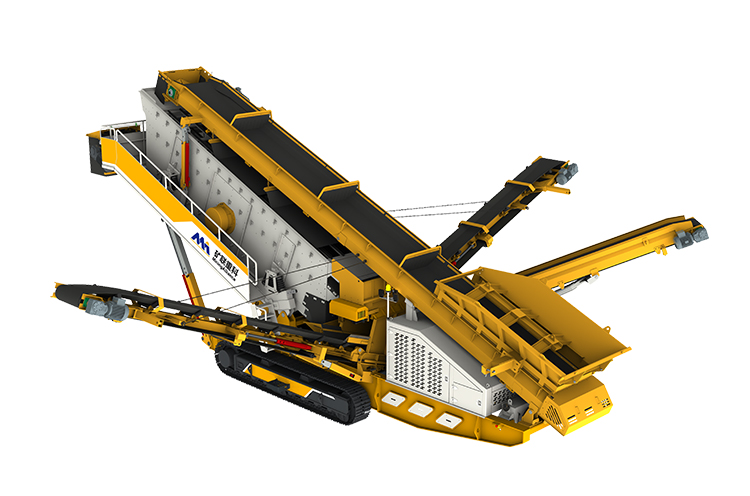
Tracked crushers: Self-propelled, rugged, and ideal for rough terrain, urban demolition sites, or uneven ground. They offer superior stability and maneuverability but can be slower to relocate between job sites.
Wheeled crushers: Faster and easier to move on public roads, suitable for projects requiring periodic relocation between nearby sites. However, they may require more stable surfaces for operation.
Single-Machine vs. Two-Stage Setups
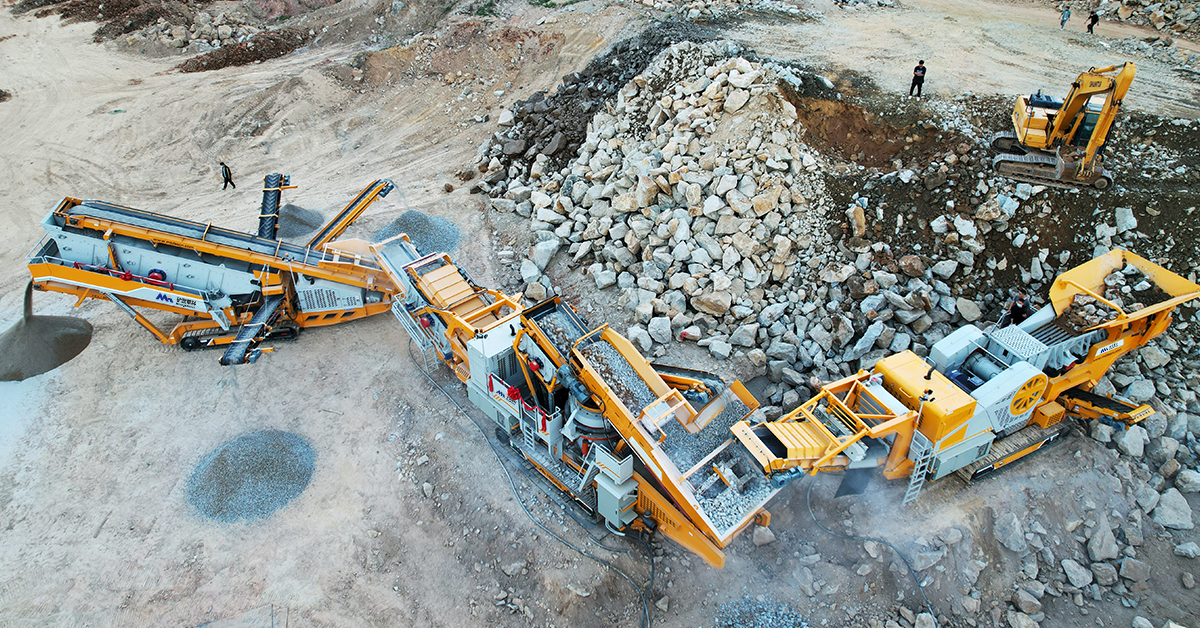
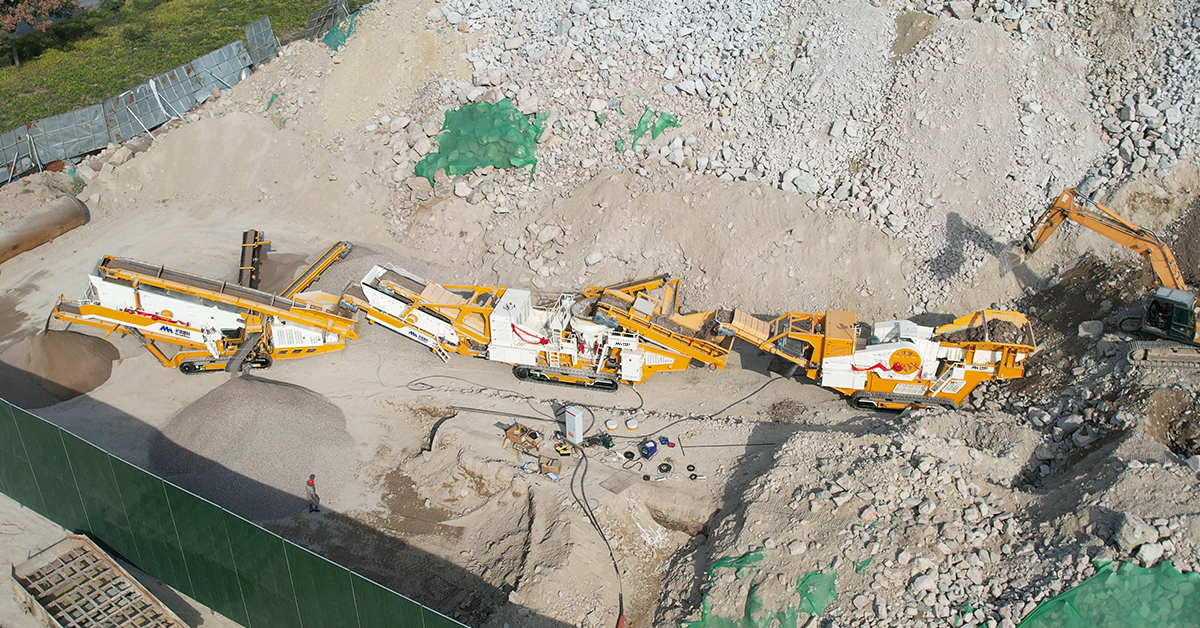
Some contractors rely on single-machine systems (often a jaw or impact crusher with an integrated screen) for simplicity and compactness. Others deploy two-stage setups for higher capacity and better quality — for example, a jaw crusher for primary processing followed by an impact crusher to refine and shape the output.
Two-stage plants yield premium aggregates fit for demanding uses like road surfacing or structural concrete. In contrast, single-stage units are more compact, affordable, and easier to mobilize — a key factor for smaller or shorter projects.
3. Top Mobile Crusher Brands and Models for Concrete Recycling
Several manufacturers dominate the mobile crushing sector, differentiated by performance, mobility, and cost-efficiency.
Many buyers choose specialized Chinese suppliers like MiningAlliance, which focus on this capacity range and provide customized tracked, wheeled, or mini mobile crushing solutions with more reasonable investment levels.
MiningAlliance positions itself between large Chinese manufacturers and international brands.
Rather than competing on scale or brand history, it focuses on project-based mobile crushing solutions, especially for tracked mobile crushers, tire mobile crushers, and mini mobile crushers used in small to mid-scale projects.
Emerging manufacturers like MiningAlliance and other Asian brands cater to budget-conscious buyers. Their compact tracked crushers offer surprising performance for a fraction of the cost of top-tier European or North American machines. While sometimes lacking in long-term refinement or resale value, they’re popular among startups seeking an affordable entry into recycling.
4. Real-World Recommendations by Scenario
Choosing the right mobile crusher depends on several variables: project size, feed material, production targets, mobility needs, and budget.
For Small Contractors or Startups (Budget: under $200–300k)
Recommendation: Compact tracked jaw crusher or small impact crusher (20–30 tons/hour).
Rationale: Portable and affordable machines minimize investment risk while letting contractors crush small demolition loads, driveways, or concrete slabs on-site. Compact units can be easily moved with a pickup or small loader.
Example models: compact offerings from MiningAlliance.
For Mid-Size Operations (Balanced Quality and Throughput)
Recommendation: Mid-size mobile impact crusher with integrated screen or a two-stage (jaw + secondary impact) setup.
Rationale: Provides good particle shape, adjustable output size, and increased throughput (100–250 tons/hour). Ideal for regional contractors handling multiple construction or road projects.
Example models: MiningAlliance mobile jaw crusher.
For Large-Scale or High-Production Jobs
Recommendation: Heavy-duty tracked jaw or two-stage plant (jaw + cone/impact).
Rationale: Designed for 300+ tons/hour and continuous operation, these machines excel in large demolition or infrastructure projects producing massive rubble volumes.
Example models: MiningAlliance (jaw) with secondary.
For Premium Aggregate Quality
Recommendation: Impact-focused setups with screening and closed-loop configuration.
Rationale: Produces superior-shaped, consistently graded aggregates suitable for high-grade concrete, asphalt, or base courses.
Example models: MiningAlliance hybrid impact crushers
For Rough Terrain or Remote Areas
Recommendation: Fully tracked crushers with hydraulic drives and on-board power generation.
Rationale: Offer self-propelled movement on uneven ground, ideal for mine sites, forest roads, or rural demolitions where grid power and smooth surfaces are lacking.